

RURAL Health Study Reveals Key Drivers of Chronic Disease in Assumption Parish
March 19, 2026 · Baton Rouge, LA
The study is evaluating health outcomes in comparable rural parishes; Assumption Parish data revealed with Franklin Parish data to follow later this year
Researchers at LSU’s Pennington Biomedical Research Center recently published the
first set of data from the Risks Underlying Rural Areas Longitudinal, or RURAL, Heart
and Lung study. The first-of-its-kind study was developed to explore why people who
live in rural areas suffer disproportionately from heart and lung diseases, stroke, diabetes and
obesity. Led by Dr. Stephanie Broyles, professor and director of the Contextual Risk
Factors Laboratory at Pennington Biomedical, the longitudinal study first gathered
data in Louisiana’s Assumption Parish and then collected data in Franklin Parish. The data book for Assumption Parish is now available to explore. For more information contact: Ernie Ballard, Senior Director of Communications & Marketing, ernie.ballard@pbrc.edu, 225-263-2677. About LSU's Pennington Biomedical Research Center The Pennington Biomedical Research Center is at the forefront of medical discovery
as it relates to understanding the triggers of obesity, diabetes, cardiovascular disease,
cancer and dementia. Pennington Biomedical has the vision to lead the world in promoting
nutrition and metabolic health and eliminating metabolic disease through scientific
discoveries that create solutions from cells to society. The Center conducts basic,
clinical and population research, and is a campus in the LSU System. The research enterprise at Pennington Biomedical includes over 600 employees within
a network of 44 clinics and research laboratories, and 16 highly specialized core
service facilities. Its scientists and physician-scientists are supported by research
trainees, lab technicians, nurses, dietitians and other support personnel. Pennington
Biomedical is a globally recognized state-of-the-art research institution in Baton
Rouge, Louisiana. For more information, see www.pbrc.edu.
Pennington Biomedical Research Center
Dr. Broyles and her team worked in both Assumption and Franklin Parishes to gather
data, and while these parishes feature similar demographics, they also experience
different health outcomes. Data gathered in Franklin will be published soon, allowing
for a greater understanding of these differences, but the Assumption Parish data also
provided key takeaways. One of these is that health is closely tied with one’s education
level, much more than one’s income or age. The study found that Assumption residents
who didn’t graduate from high school are more than twice as likely to have high blood
pressure and high cholesterol.
“These initial data open up a lot more questions, but we see them as conversation
starters, not conversation enders,” said Dr. Broyles. “Why is it we’re seeing more disease in
people with lower education levels? Is it because they’re working in jobs that don’t carry
health insurance? Is it because they know less about behaviors that could improve
their health? We’re not sure, and it’s premature to assume why we’re seeing these
patterns. Just because there is a strong correlation between two data points doesn’t mean
one is the cause of the other.”
The research team identified insights from the Assumption Parish data that build a
more complete profile of the parish and may explain why a disparity in health exists
among rural parishes. For example, Assumption Parish has a lower population density, a higher
proportion of older adults, and a lower median household income. The parish faces
a higher prevalence of obesity, hypertension, and diabetes, which are associated with preventable
risk factors. Environmental constraints also contribute to the disparity, as not only
do residents have limited access to healthy food options, but they also have access
to fewer primary care providers and specialty services, with residents needing to
travel long distances to reach necessary care.
In Assumption Parish, 80% of adults have overweight or obesity. That is higher than
in Louisiana overall (72%) and in the U.S. (68%). Obesity rates differ the most by
education level: 75% of those who didn’t complete high school have obesity compared
to 48% of those who attended at least some college. High cholesterol and high blood
pressure are more than twice as common in the less educated group.
“With the Franklin Parish results on the way, we will soon have a clear picture of
disparities between higher-risk and lower-risk rural communities,” said Dr. Broyles.
“What we are observing now is that not all rural communities are the same, and the
differences that exist matter for health. Where you live in Louisiana may play a significant
role in how long and how well you live.”
The RURAL study team explored the information to determine the drivers of health disparities
that persist among similar rural areas. Assumption and Franklin are just two of 10
counties in the United States that are participating in the RURAL study, as the study
is also active in Mississippi, Alabama and Kentucky. The study is supported across these four states by grants from the National Institutes of Health totaling $43.9 million over five years.
The RURAL study includes teams of scientists from 16 different institutions, including
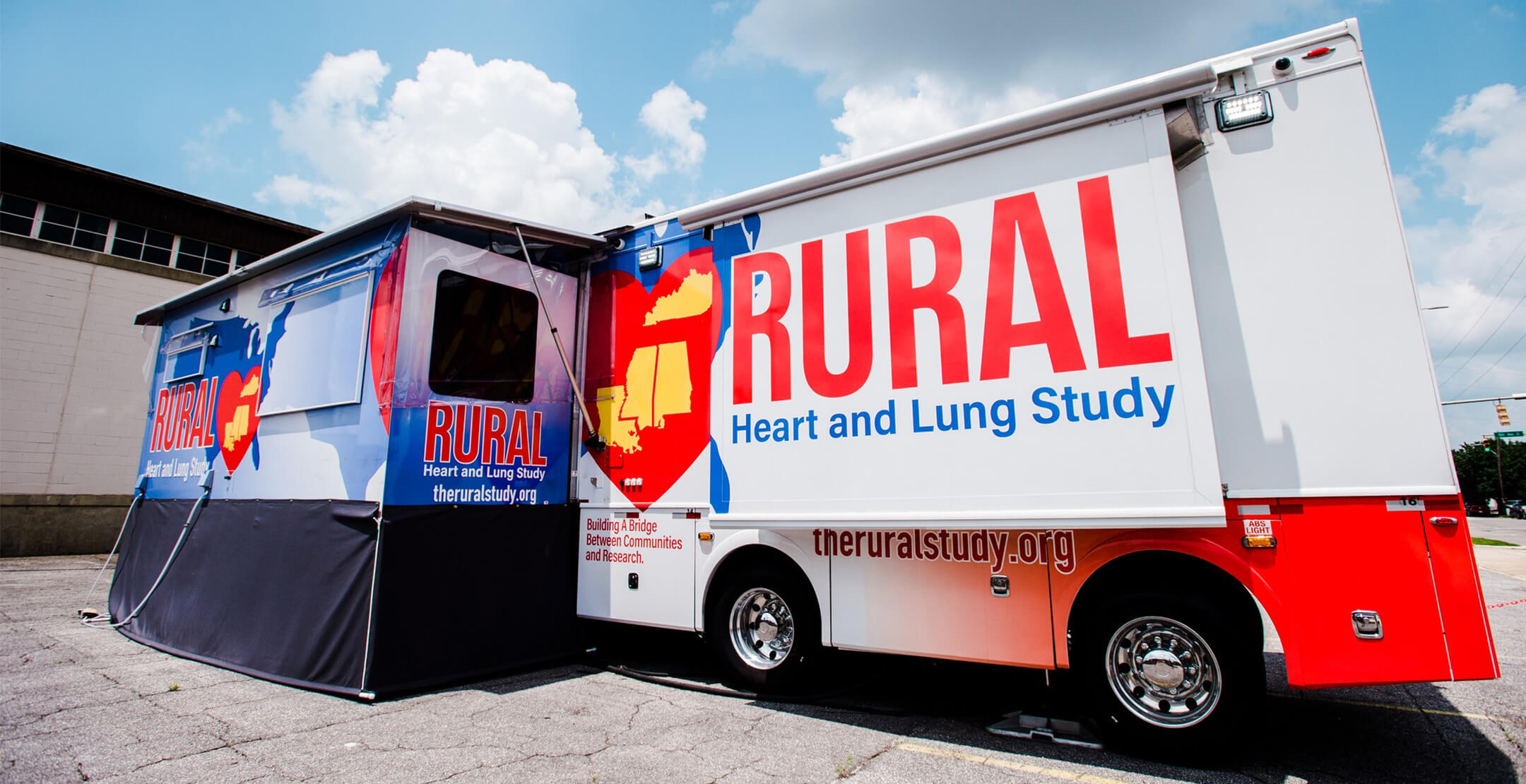
Pennington Biomedical. To gather the research data, a special vehicle – the mobile
examination unit – traveled to both Assumption and Franklin parishes in 2024. Collecting
data from 460 Assumption Parish adults, each participant spent approximately three
hours in the unit, answering questions and going through a variety of screenings,
including urine and blood collection to measure blood sugar and cholesterol, an echocardiogram,
a CT scan, and a pulmonary function test. The same participants will be evaluated
again in 2028 to see how their health has evolved over time.
6400 Perkins Road
Baton Rouge, LA 70808


