

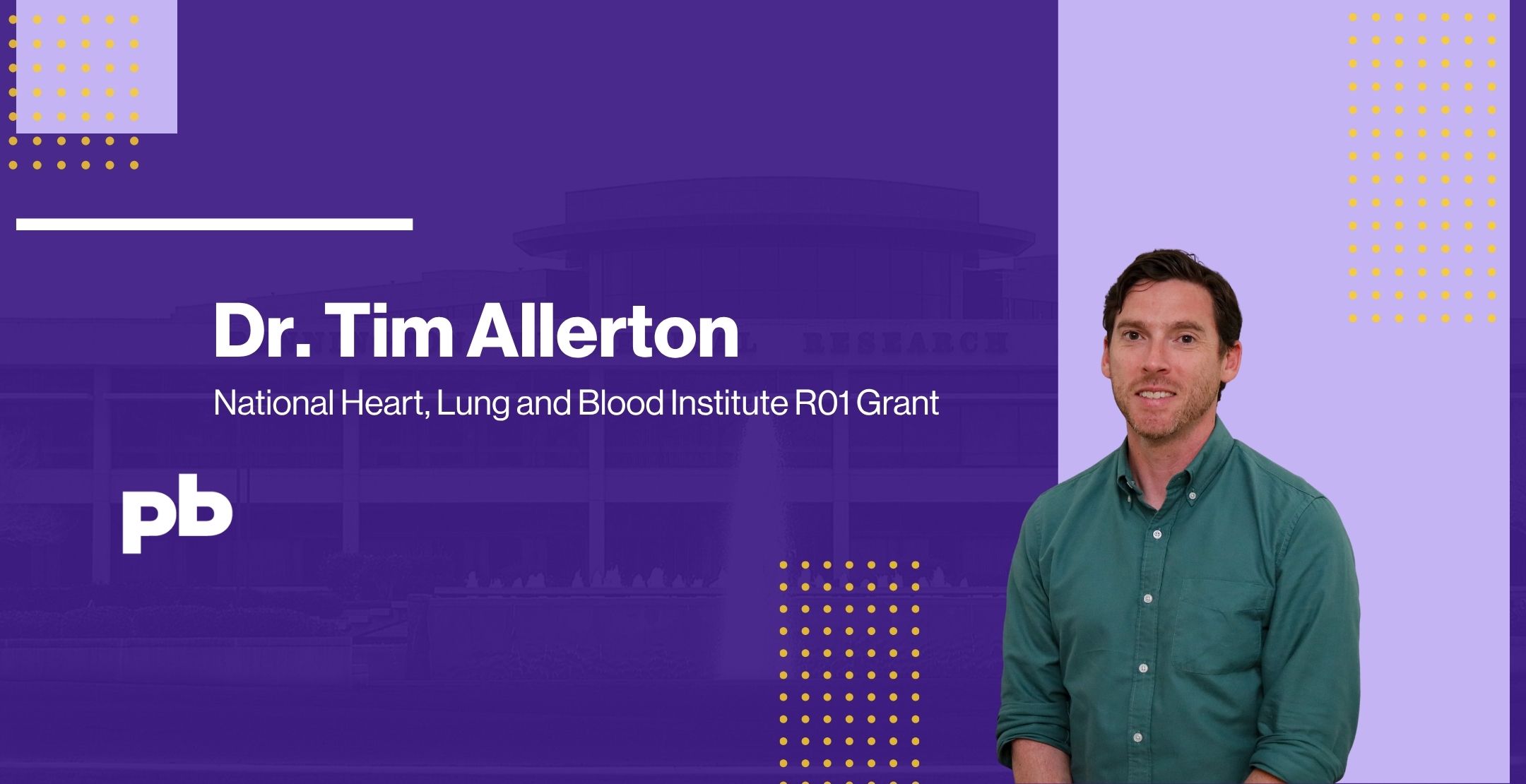
Dr. Tim Allerton Awarded Up to $3.6 Million NIH Grant to Study New Approach to Advance Heart Failure Research
July 9, 2026 · Baton Rouge, LA
Prestigious NIH R01 award recognizes scientific excellence and supports Dr. Allerton’s research into one of the fastest-growing forms of heart failure
Dr. Tim Allerton, Assistant Professor and Director of the Vascular Metabolism Laboratory at LSU’s Pennington Biomedical Research Center, has been awarded a prestigious National Institutes of Health (NIH) R01 research grant totaling up to $3.6 million to investigate a promising new approach to treating one of the fastest-growing forms of heart failure.
The five-year grant from the NIH National Heart, Lung and Blood Institute will support research into heart failure with preserved ejection fraction (HFpEF), a condition that affects millions of Americans and is now the most common form of heart failure. Unlike other forms of heart failure, people with HFpEF have a heart that ejects a normal amount of blood with each beat. However, the heart muscle has difficulty relaxing and filling properly, which can lead to debilitating fatigue and exercise intolerance. Research from Dr. Allerton’s laboratory has shown that these symptoms are also driven by abnormalities in skeletal muscle and blood vessel function, which further impair exercise capacity and overall physical function.
Dr. Allerton's research will explore the role of hydrogen sulfide (H₂S), a naturally occurring molecule that helps regulate metabolism, blood flow and cardiovascular health. His team aims to determine how declining H₂S levels contribute to poor muscle function and reduced exercise capacity in patients with HFpEF and evaluate a novel therapy designed to restore healthy muscle metabolism.
“This award allows us to investigate a completely new therapeutic strategy for a condition that currently has very few treatment options,” Dr. Allerton said. “Our previous research suggests hydrogen sulfide plays a critical role in how skeletal muscle produces energy and how blood vessels deliver oxygen during exercise. By understanding these mechanisms, we hope to develop therapies that help people with HFpEF become more active, improve their daily function and ultimately enhance their quality of life.”
HFpEF is commonly associated with obesity, high blood pressure and Type 2 diabetes. Exercise intolerance is the hallmark symptom of the disease and one of the strongest predictors of hospitalization and death. Dr. Allerton's preliminary research found that patients with HFpEF have dramatically reduced levels of hydrogen sulfide, resulting in impaired muscle metabolism and decreased blood flow. In preclinical studies, restoring hydrogen sulfide levels improved muscle function and exercise capacity.
The new study will examine how hydrogen sulfide is produced and utilized by skeletal muscle and blood vessels during the progression of HFpEF. Researchers will also test a first-of-its-kind therapy that delivers hydrogen sulfide directly to mitochondria – the intracellular structures responsible for producing energy – to determine whether it can improve exercise performance.
“Receiving an NIH R01 award is a significant achievement and reflects the scientific excellence and innovation of Dr. Allerton's research program,” said Dr. Jennifer Rood, Interim Senior Vice Chancellor and Executive Director of Pennington Biomedical. “Dr. Allerton’s pioneering research has helped position Pennington Biomedical as a major leader in cardiometabolic disease research by advancing our understanding of how vascular and skeletal muscle dysfunction contribute to heart failure with preserved ejection fraction. By bringing together expertise in vascular biology, skeletal muscle metabolism and exercise physiology, this research has the potential to uncover new treatment strategies that could improve the lives of millions of people living with heart failure.”
The NIH R01 grant is the agency's flagship mechanism for supporting investigator-initiated research and is among the most competitive forms of federal biomedical research funding. The award recognizes the scientific merit and potential impact of Dr. Allerton's work while supporting discoveries that advance the understanding and treatment of chronic disease.
The project is funded by the National Heart, Lung and Blood Institute, part of the National Institutes of Health, and provides up to $3,583,010 over five years, contingent upon available funding and satisfactory research progress.
For more information on Dr. Allerton’s research, visit https://www.pbrc.edu/research-and-faculty/research-programs/Basic-Science-Labs-and-Programs/vascular-metabolism-lab.aspx.
For more information contact:
Ernie Ballard, Senior Director of Communications & Marketing, ernie.ballard@pbrc.edu, 225-263-2677.
About LSU's Pennington Biomedical Research Center
The Pennington Biomedical Research Center is at the forefront of medical discovery as it relates to understanding the triggers of obesity, diabetes, cardiovascular disease, cancer and dementia. Pennington Biomedical has the vision to lead the world in promoting nutrition and metabolic health and eliminating metabolic disease through scientific discoveries that create solutions from cells to society. The Center conducts basic, clinical and population research, and is a campus in the LSU System.
The research enterprise at Pennington Biomedical includes over 600 employees within a network of 44 clinics and research laboratories, and 16 highly specialized core service facilities. Its scientists and physician-scientists are supported by research trainees, lab technicians, nurses, dietitians and other support personnel. Pennington Biomedical is a globally recognized state-of-the-art research institution in Baton Rouge, Louisiana. For more information, see www.pbrc.edu.
Pennington Biomedical Research Center
6400 Perkins Road
Baton Rouge, LA 70808


