

Historical Timeline

When the Pennington Biomedical Research Center opened its doors in 1988, the original mission statement was brilliantly simple: to improve the quality and length of life by studies of the effect of nutrition and other lifestyle factors on health and life span.
Since its founding, Pennington Biomedical has led the scientific community in achieving breakthrough research in nutrition, obesity and diabetes. For more than 35 years, our scientists have helped to achieve and surpass Doc Pennington's mission by uncovering groundbreaking science in how diet, exercise and lifestyle affect the human body.
Click on a era below to explore significant historical details and events of Pennington Biomedical.
- Dr. Jennifer Rood became Interim Senior Vice Chancellor and Executive Director of Pennington Biomedical.
- Dr. Candida Rebello secured a $3.7 million, five-year R01 grant from NIH’s National Institute on Aging to explore lifestyle-focused care strategies to reduce excess body fat and declining muscle mass in older adults with obesity, also known as sarcopenic obesity. The grant facilitates the planning and structure of the clinical trial laid out in her project “Lifestyle intervention to improve muscle function in older adults.”
- Elizabeth Stanley named Associate Executive Director of Operations and CFO.
- Dr. Corby Martin named the Louisiana Public Facilities Authority (LPFA) Endowed Chair in Nutrition, a chair established through private donations matched by the Louisiana Board of Regents Support Fund.
- Dr. Owen Carmichael awarded the James W. and Neil Ann Parks Professorship for Dementia Research, Prevention and Treatment.
- Dr. Tim Allerton was awarded a NIH R01 research grant totaling up to $3.6 million to investigate a promising new approach to treating one of the fastest-growing forms of heart failure.
- The Center earned its fifth renewal for the Nutrition Obesity Research Center (NORC) from the National Institute of Diabetes and Digestive and Kidney Diseases. The award, totaling $5,659,389, extends support for the Pennington-Louisiana Nutrition Obesity Research Center through 2031 and reaffirms Pennington Biomedical's position as a national leader in nutrition, obesity and metabolic health research.
- In 2025, researchers secured a total of 50 new awards, including several multimillion-dollar studies in obesity, metabolism, theranostics and pediatric health. The Center successfully renegotiated or reinstated multiple federal grants, preserving program continuity. Active funding from federal sources exceeded $55 million in 2025.
- Four researchers from LSU’s Pennington Biomedical Research Center – Dr. Steven Heymsfield, Dr. Peter Katzmarzyk, Dr. Eric Ravussin, and Dr. Donna Ryan – were named among the world’s most highly cited scientists, according to the 2025 Highly Cited Researchers list from Clarivate Analytics.
- Dr. Corby Martin was appointed as the Associate Executive Director for Scientific Education. This appointment came as Dr. Leanne Redman transitioned to an extraordinary opportunity as Executive Director of the Charles Perkins Centre at the University of Sydney, one of the world's premier obesity and metabolic health research institutes.
- The National Institutes of Health funding for Pennington Biomedical’s Metabolic Basis of Disease Center of Biomedical Research Excellence (COBRE) was renewed for an additional five years. This Phase II renewal of $10.9M builds on the momentum achieved since the center’s establishment in 2020, enabling continued support for young scientists who are focused on the mechanisms through which nutrition and metabolism contribute to health.
- Louisiana’s Environmental Influences on Child Health Outcomes, or ECHO program, has secured a share of $13 million in funding from the National Institutes of Health, or NIH. The award, which is for the program’s third award cycle, will support its efforts and research for five years.
- Dr. Steven B. Heymsfield, Professor of Metabolism and Body Composition, was named a Boyd Professor of Louisiana State University – the highest faculty rank and honor awarded within the LSU System.
- Dr. Catherine Champagne and Dr. Stefan Pasiakos were named Excellence in Nutrition Fellows, and Dr. Leanne Redman received the McCollum Award, both from the American Society of Nutrition.
- The Scientific Education division supported 36 postdoctoral researchers, and hosted several symposia and training programs, including the NIDDK Methods Course, all intended to support and prepare the next generation of research scientists.
- The Greaux Healthy team was instrumental in bringing back Pennington Biomedical’s popular Childhood Obesity Conference in October.
- Three researchers from Pennington Biomedical Research Center – Dr. John Kirwan, Dr. Eric Ravussin and Dr. Phil Schauer – served on the Lancet Commission on Clinical Obesity, a global group that generated a new approach to diagnosing clinical obesity. The diagnosis is based on evaluations in addition to body mass index, or BMI, such as measures of excess body fat and objective signs and symptoms of ill health at the individual level.
- The Dietary Approaches to Stop Hypertension, or DASH, Diet, developed in part by Pennington Biomedical Research Center scientists, has been recognized as the best heart-healthy diet in the 2025 U.S. News & World Report Best Diets Rankings.
- Steven Heymsfield and Dr. Peter Katzmarzyk named among the most influential researchers in the world who demonstrate significant and broad influence in their fields, according to Clarivate Analytics’ 2024 List of Highly Cited Researchers.
- Pennington Biomedical was awarded a new Obesity Medicine Fellowship from the U.S. Obesity Medicine Council that will begin in 2025. The program, the first of its kind in Louisiana, is a collaboration between Pennington Biomedical and LSU Health New Orleans School of Medicine.
- Dr. Jackie Stephens was elected Vice President of The Obesity Society's Governing Board Executive Committee in a special election.
- Leanne Redman was named new director of Pennington Biomedical’s Nutrition Obesity Research Center, or NORC. The Pennington Biomedical/Louisiana NORC is one of 11 across the U.S. funded by the National Institute of Diabetes and Digestive and Kidney Diseases.
- Leading medical institutions in the Middle East and Pennington Biomedical begin exploring collaborations to address one of the most critical public health challenge facing the world today – obesity.
- Further cementing the Center’s commitment to improving health and well-being across Louisiana and beyond, the Greaux Healthy initiative officially launched in 2024. Developed with funding from the State of Louisiana, Greaux Healthy implements 35 years of Pennington Biomedical research and discoveries to inform tools, resources and programing for children, parents, physicians and educators throughout the state.
- Pennington Biomedical was named a spoke in both the Customer Experience and Investor Catalyst Hubs of the Advanced Research Projects Agency for Health, or ARPA-H, a nationwide health innovation network headquartered in the Department of Health and Human Services in Washington, D.C.
- The "Small Shifts" campaign launches, encouraging little changes that can have a big impact over time.
- US News & World Report ranks the DASH, Diet, as one of the best diets overall , a top heart-healthy and diabetes diet in the 2024 Best Diets rankings.
- Dr. Claude Bouchard, along with his wife, Monique Chagnon, pledged $1 million to create the endowed Claude Bouchard-Monique Chagnon Fund to support postdoctoral fellows in basic research, as well as in clinical and public health and population science.
- The National Institutes of Health launched its landmark initiative to advance nutrition research.Nutrition for Precision Health, powered by the All of Us Research Program, or NPH, is working with 14 sites across the United States – including Pennington Biomedical – to engage 10,000 participants from diverse backgrounds and learn more about how our bodies respond differently to food.
- Innovation and commercialization at Pennington Biomedical received a new emphasis with the partnership between seasoned business tech transfer professional Patrick Reed, RTTP, and Associate Professor Kenneth Eilertsen, who has vast experience in basic research and creating startup biotech companies.
- Dr. Amanda Staiano, director of the pediatric obesity and health behavior laboratory, served as a co-author on the the American Academy of Pediatrics' first comprehensive guidelines in 15 years on evaluation and treatment of children and adolescents with obesity.
- Dr. Leanne Redman was named the recipient of The Obesity Society’s 2023 TOPS Research Achievement Award, the most prestigious award for obesity research in North America.
- Five Pennington Biomedical Research Center faculty members and one adjunct professor rank among the most cited researchers in the world, according to the Google Scholar Citations database.
- A number of Basic Science faculty received research awards , including research projects being led by Dr. Ji Suk Chang, Dr. Stephania Cormier, Dr. Wagner Dantas, Dr. Yanlin He, Dr. David McDougal, Dr. Krisz Stadler, and Dr. Robert Kesterson.
- Pennington Biomedical welcomed scientists from around the world for the Center’s Executive Advisory Board on-site visit., which occurs every every two years and helps evaluate the Center’s vision, mission and priorities for future development.
- The new Bioinformatics and Computational Biology Core was established, and Dr. Sujoy Ghosh was hired to head this new area.
- Prachi Singh was awarded a $3.7 million grant from the NIH’s National Heart, Lung, and Blood Institute to study the cardiovascular risks of limited sleep.
- Postdoctoral researcher Flori Corpodean was selected for a prestigious, nationally competitive resident research award from the Society for Surgery of the Alimentary Tract, which will provide $25,000 to further support her research.
- Robert L. Newton, Jr., was selected to receive a Google Health Equity Research Initiative award, titled “Population and Public Health: Increasing physical activity in Black communities living in rural environments.”
- Melissa Martin, a registered dietitian with more than 10 years’ experience in patient care at various health systems, was named director for the state-funded Greaux Healthy initiative.
- The Louisiana Obesity Society hosted its inaugural conference, in conjunction with the Louisiana Chapter of American Society of Metabolic and Bariatric Surgery, in New Orleans.
- The Center relaunched the Men’s Health Summit and hosted more than 600 people at the Irene W. Pennington Wellness Day for Women and more than 200 at the Senior Black American Health Fair.
- The nation’s first integrated, interdisciplinary metabolic treatment center, the Metamor Institute, officially opened its doors to patients.
- Steven B. Heymsfield and Justin C. Brown are part of a team led by the Rutgers Cancer Institute of New Jersey, Weill Cornell Medicine and Cold Spring Harbor Laboratory that secured $25 million to take on the challenge of cachexia, the debilitating wasting condition responsible for up to 30 percent of cancer deaths.
- Awarded a $20 million, five-year grant from NIH that will allow the LA CaTS Center to continue its work to make Louisiana healthier by addressing health disparities and improving health outcomes in the state’s underserved population with chronic diseases by funding research partner institutions.
- Pennington Biomedical received a $3.6M award from the US Department of Defense aimed at creating new nutrition approaches and programs to improve mental resilience and mitigate the effects of stress for members of the US military. Drs. Jennifer Rood and Tiffany Stewart are the project leaders for this Center of Excellence in Military Health and Performance Enhancement.
- Drs. Eric Ravussin and Leanne Redman received a new five-year, $8.6M grant, Nutrition for Precision Health, to learn how to predict how an individual responds to a given diet, allowing physicians to offer patients personalized nutrition prescriptions to improve health and treat chronic diseases.
- John Kirwan, Pennington Biomedical Executive Director, participated in the historic White House Conference on Hunger, Nutrition and Health — the first White House Conference on hunger, nutrition and health in over 50 years.
- Five current and former renowned Pennington Biomedical scientists are among the most cited researchers in the world.
- Pennington Biomedical is heading a consortium of the state’s leading biomedical research institutions, including LSU Health New Orleans, to investigate the consequences of long COVID under a NIH grant award.
- Pennington Biomedical hosts the inaugural Senior Black American Health Fair, the first public outreach effort of its kind.
- The Division of Scientific Education hosted the 2022 Scientific Symposium on “Biological and Behavioral Mechanisms of Weight Loss Maintenance” on April 24-26.
- Dr. Peter Katzmarzyk received the 2022 ACSM Citation Award for his significant contributions to sports/medicine and exercise science.
- The State of Louisiana provides funding for an evidence-based public service initiative, called Greaux Healthy, to help in the prevention and treatment of childhood obesity.
- Launched Obecity, USA, a historic, public service campaign to raise awareness of obesity as a disease.
- Christopher Morrison, PhD, Professor and Director, Neurosignaling Laboratory, was named Associate Executive Director for Basic Science. Dr. Morrison also holds the endowed John S. McIlhenny Professorship of Nutritional Neuroscience.
- Robert L. Newton Jr., Associate Professor and Director, Preventive Behavioral Medicine Laboratory, accepted a two-year term as Chairperson of the Lifestyle Change and Behavioral Health Study Section for the National Institutes of Health’s Center for Scientific Review.
- Dr. Steven Heymsfield was named an Amazon Scholar. In this prestigious role, he will help develop digital health and wellness tools for the Amazon Halo organization.
- Pennington Biomedical serves as a the first COVID-19 mass vaccination site in the Baton Rouge area for Our Lady of the Lake Regional Medical Center. The COVID-19 vaccination clinic is capable of vaccinating more than 7,500 people per week.
- The Bariatric and Metabolic Institute (BMI) opens on the Pennington Biomedical campus. For the first time in its history, Pennington Biomedical begins treating patients using methods identified in earlier scientific discoveries.
- The Metabolic Basis of Disease Center is funded by the National Institutes of Health. The center will pioneer research to understand metabolic components of various disorders and diseases including Diabetes, Preeclampsia & Anxiety behaviors.
- Leanne Redman, PhD, Professor and Director, Reproductive Endocrinology & Women's Health Laboratory, was named Associate Executive Director for Scientific Education. Dr. Redman is Program Director on Pennington Biomedical's most recent renewal of the Training in Obesity Research National Institutes of Health T32 award. The grant funding is used to train postdoctoral fellows.
- Cleveland Clinic, Pennington Biomedical Research Center host Cleveland Clinic’s 14th Annual Obesity Summit
- Pennington Biomedical secures $16.4 Million in defense work. Scientists begin research studying strategies to maintain normal testosterone levels under extreme conditions to offset warfighter muscle loss.
- Pennington Biomedical joins scientists, physicians, and clinical exercise specialists from across the country in the landmark National Institutes of Health (NIH) effort to find out what happens at the molecular level when people exercise. The study is named MoTrPAC, (Molecular Transducers of Physical Activity Consortium).
- Pennington Biomedical hosts 17 of the most respected scientists in cancer research for an international scientific symposium. It is the research center's first scientific symposium to focus on cancer.
- Pennington Biomedical, Our Lady of the Lake Regional Medical Center, Louisiana Economic Development, LSU Health New Orleans and the Office of the Governor join forces to establish a new bariatric/metabolic surgery program. Dr. Philip Schauer, who helped pioneer laparoscopic bariatric surgery, is recruited to head the Bariatric and Metabolic Institute. The institute is expected to create 55 direct jobs with an average salary of $125,000. The Baton Rouge Area Chamber chooses the institute as its 2019 Project of the Year.
- Pennington Biomedical celebrates 30 years of growth and discoveries.
- The CALERIE 2 study shows reducing calories by 12 percent for two years slowed aging and metabolism and protected against age-related disease. The findings of the longest-running calorie restriction trial suggest calorie restriction sustained over several years may lower the risk of chronic disease and prolong life.
- Pennington Biomedical marks 30 years of research for the military including 130 studies related to warfighter health. The center's first research project looked at the effects of diet on U.S. Army soldiers’ performance.
- Steven Heymsfield, MD, FTOS, professor and director of the Metabolism and Body Composition Laboratory, is elected president of The Obesity Society.
- Pennington Biomedical receives the first in a series of major research grants that investigate brain health among participants in the Bogalusa Heart Study, a landmark study of lifelong cardiovascular health.
- John Kirwan, director of the Metabolic Translational Research Center and professor of molecular medicine at the Cleveland Clinic, is named executive director of Pennington Biomedical Research Center, replacing Interim Executive Director, Dr. Donna Ryan. He is the sixth executive director in the center's 30-year history.
- Pennington Biomedical was recognized by the American Heart Association as a Platinum Fit-Friendly Worksite for taking great strides to improve the well-being of employees by creating a culture of wellness and providing more options to make healthy choices.
- Pennington Biomedical was designated as a Level 1 Well-Ahead Well Spot by the Louisiana Department of Health and Hospitals, a distinction that honors a commitment to wellness.
- Pennington Biomedical partnered with the Louisiana Department of Health and Hospitals, the Louisiana Department of Education and the Tulane School of Public Health to encourage less screen time for children.
- Dr. Claude Bouchard, who holds the John W. Barton, Sr. Endowed Chair in Genetics and Nutrition, was named an LSU Boyd Professor, the highest and most prestigious academic rank.
- Dr. Steve Heymsfield was awarded the 2016 George A. Bray Founders Award from The Obesity Society, an honor presented to individuals who have made a significant contribution to the scientific or clinical basis for understanding and treating obesity.
- Pennington Biomedical hosts 21 of the world’s most respected scientists for its first international scientific symposium focused on neuroimaging.
- Pennington Biomedical releases the Childhood Obesity Treatment Toolkit, which provides integrative strategies to pediatricians for reducing and treating childhood obesity across Louisiana.
- Pennington Biomedical plays a role in two of the largest-ever genome-wide studies of obesity, which could lead to a better understanding of the causes of the disease and new evidence-based treatments.
- A collaboration between Pennington Biomedical and its partners concludes with the release of the Healthy Communities – West Carroll initiative, a report that identifies health disparities in the area and provides a path forward to improving health for the parish’s at-risk residents.
- A new discovery shows that mice lacking a certain gene in their skeletal muscle that allows their bodies to burn fat, adapted to burn sugar instead. This finding could lay the foundation for future development of new treatments for obesity-related conditions such as diabetes and pre-diabetes.
- A Pennington Biomedical collaboration shows that adding the medication liraglutide to a regimen of diet and exercise boosts weight loss and improves metabolic control.
- The Botanical Dietary Supplements Research Center (formerly BRC) receives a $9.2 million, 5-year grant from the National Institutes of Health’s (NIH) Office of Dietary Supplements (ODS) and the National Center for Complementary and Integrative Health (NCCIH), which allows work to continue investigating native plants, botanical extracts and other natural products as prospects for the prevention and treatment of obesity, diabetes and other chronic diseases.
- Pennington Biomedical’s Doc’s DASH 5k and 1-mile fun run grows in attendance during its second year.
- The CALERIE study shows that restricting calories by 25 percent daily over a two-year period, the significant weight and fat loss, along with marked improvements in metabolism and other health indicators, may lead to healthier aging by reducing risk factors for chronic disease.
- The Elite Health and Wellness Program launches for community members who are interested in losing weight and learning more about their health.
- Basic science researchers discover two new molecules that reduce inflammation without inducing diabetes, as some steroids do with long-term use.
- The results of the landmark SPRINT study show that more intensive management of high blood pressure significantly reduces rates of cardiovascular disease and lowers risk of death in a group of adults 50 years and earlier with high blood pressure. The target systolic pressure in this study is 120 mm HG, as compared with the previous target systolic pressure of 140 mm Hg.
- Pennington Biomedical is awarded a $10 million grant from the Patient-Centered Outcomes Research Institute (PCORI) to study the comparative effectiveness of obesity treatment options for underserved populations delivered in primary care settings.
- The Translational Research Clinic for Children (TReCC) opens to research and fight childhood obesity.
- Pennington Biomedical is designated as an Alzheimer's Disease Cooperative Study (ADCS) site, making it the only site within a tri-state area with the designation.
- Dr. David Winwood is named Pennington Biomedical's first Chief Business Development Officer.
- A new health technology program using internet and smartphone apps is developed to target soldier readiness and resilience, called Army H.E.A.L.T.H.: Healthy Eating Activity and Lifestyle Training Headquarters.
- Pennington Biomedical's new Biomedical Imaging Center is inaugurated. Dr. Owen Carmichael is named the inaugural Director of Biomedical Imaging.
- Pennington Biomedical kicks off its premier community health event, Doc’s DASH 5k and 1-mile fun run, which brought more than 1,000 people to campus.
- Pennington Biomedical is awarded a $16 million grant by the U.S. Dept. of Defense to support optimal nutrition, fitness, combat readiness, warfighter performance and resilience.
- Dr. William Cefalu is named Pennington Biomedical's executive director.
- Pennington Biomedical's human research protection awarded accreditation by the Association for the Accreditation of Human Research Protection Programs (AAHRPP).
- The E-Moms study begins and aims to aid women receiving Women, Infants and Children (WIC) benefits in losing the weight gained during their pregnancy through a smartphone app.
- The D2d (Vitamin D and Type 2 Diabetes) study kicks off to determine if vitamin D helps prevent diabetes.
- The NIH awards Pennington Biomedical $20 million to create the Louisiana Clinical and Translational Science Center (LA CaTS) with Pennington Biomedical as the lead agency.
- The NIH awards Pennington Biomedical a $2.3 million grant to improve the health and well-being of female collegiate athletes.
- Dr. Eric Ravussin is named Boyd Professor, the LSU system's highest rank.
- The DASH diet is selected for the first time by U.S. News and World Report as the No. 1 diet in America after Pennington Biomedical's contributions. It still tops the list today.
- The NIH-funded Look AHEAD study shows weight loss and increased physical fitness nearly half the risk of losing mobility on overweight or obese adults with type 2 diabetes.
- Pennington Biomedical is recognized as one of the highest-ranked institutions in The Scientist as the fourth-best place to work for postdocs.
- Dr. Phillip Brantley is awarded $9.9 million from the Office of Group Benefits to study the health benefits and cost effectiveness of medical and surgical treatments for obesity.
- Pennington Biomedical is awarded a $6 million grant from the U.S. Department of Defense for Army warfighter research.
- Pennington Biomedical is awarded a $5.2 million grant from LSU Health Care Services Division (now LSU Health) for a state-of-the-art learning community aimed at improving health system quality.
- The NIH awards Pennington Biomedical $3.5 million for the Expecting Success program, which aims to improve weight management in pregnant women.
- The ASPREE study is funded by the NIH to determine if a daily aspirin regimen can lower the risk of developing dementia and cardiovascular disease.
- The SPRINT study is funded by the NIH to determine if reducing systolic blood pressure to a lower goal than currently recommended will reduce cardiovascular disease.
- Pennington Biomedical partners with Blue Cross and Blue Shield of Louisiana Foundation to create Challenge for a Healthier Louisiana, which fights obesity across the state.
- Louisiana's Report Card on Physical Activity and Health for Children and Youth is released for the first time as part of Pennington Biomedical's childhood obesity initiative.
- Dr. Steven Heymsfield is named Pennington Biomedical's executive director.
- The Diabetes Prevention Programs Outcomes Study results are published, showing lifestyle changes designed to achieve and maintain modest weight loss reduce the rate of developing type 2 diabetes by 34 percent over ten years.
- Pennington Biomedical celebrates its 20th anniversary.
- During a special session, the Louisiana State Legislature approves $50 million in funding to complete a new clinic building, renovate the existing clinic and provide other campus improvements and research equipment.
- The Conference on 20 Most Significant Achievements in Obesity Research, Treatment and Prevention convenes at Pennington Biomedical.
- The Louisiana State Legislature awards Pennington Biomedical it's first-ever construction award of $21 million to fund construction of a new clinical facility.
- A new population science annex is completed.
- The NIH awards funding to the Center to create the Center for Biomedical Research Excellence (COBRE).
- The Center of Excellence in Botanicals and Metabolic Syndrome is created with the first NIH center grant to Pennington Biomedical to focus basic research on whether plants and extracts can effectively treat type 2 diabetes and metabolic syndrome. It is one of only five such research centers in the nation.
- The John S. McIlhenny Laboratory of Botanical Research is also created.
- The second NIH center grant to Pennington Biomedical is won by a team led by Eric Ravussin, Ph.D. to study prenatal causes of obesity.
- The William Hansel Laboratory of Cancer Prevention is created.
- Themelios—a fund to finance development of early-stage Center discoveries—is created with a $10 million initial investment from the Pennington Family Foundation.
- Pennington Biomedical awards its first honorary doctorate to Dr. Douglas Coleman for research on diabetes and obesity that provided the foundation for advances in understanding of energy balance regulation.
- The 187,000-foot basic science laboratory building opens.
- "Step by Step, Kids Trimming Down" is produced by Louisiana Public Broadcasting, which again features Pennington Biomedical researchers.
- "Kids: Trying to Trim Down" is produced by Louisiana Public Broadcasting, featuring Pennington Biomedical researchers and is seen across the country.
- Paula Pennington de la Bretonne, Doc's granddaughter, is named Chairman of the Board.
- Irene Pennington, Doc's wife, passes away at 104 years old.
- Planning begins for the first International Scientific Symposium, and the series continues today.
- The NIH awards a $12.4 grant to Dr. Eric Ravussin to study whether long term calorie restriction has anti-aging benefits. It is the largest grant to date.
- Pennington Biomedical concludes the NIH-funded Diabetes Prevention Program (DPP). The results show that at least 10 million Americans who are at high risk for type 2 diabetes can sharply lower their chances of being diagnosed with the disease through diet and exercise.
- Drs. David York and Leslie Kozak are awarded a five-year, $6 million grant to discover genes associated with obesity.
- Total grants from the NIH reach $5.5 million and exceed state appropriations for the first time.
- Dr. Claude Bouchard becomes the second executive director after Dr. George Bray steps down to resume full-time research.
- Dr. George Bray is named a Boyd Professor, the LSU system's highest rank.
- An extension of the comparative biology building is completed.
- Pennington Biomedical's website goes live and allows for better recruiting and postdoctoral programs.
- DASH diet results are published in the New England Journal of Medicine, which shows the diet significantly lowers blood pressure.
- The NIH awards Pennington Biomedical funding to participate in a second study of dietary patterns and blood pressure, along with Johns Hopkins, Duke and Harvard Universities.
- C.B. "Doc" Pennington passes away at 97.
- The USDA funds the Lower Mississippi River Delta Nutrition and Health Initiative to study nutrition intervention in the Mississippi River delta regions of Arkansas, Louisiana and Mississippi.
- The Transgenic Laboratory is completed.
- Pennington Biomedical hosts the Nutrient Database Conference and North American Association for the Study of Obesity annual meetings.
- The National Dairy Council awards funding for studies of dietary fat, genetics, and heart disease.
- Center employment totals 269 scientists and support staff.
- The NIH selects Pennington Biomedical to help study the effect of diet on blood pressure, resulting in the DASH diet (Dietary Approaches to Stop Hypertension, a five-time award-winning "best diet" by U.S. News & World Report, which still tops the list today.)
- NASA funds a study about the role nutrition and metabolism play in preventing bone and muscle loss during long-term space flight.
- The C.B. Claude Pennington Jr. Nutrition Conference and Education Center is completed.
- Pennington Biomedical is awarded its first pharmaceutical research grant.
- Pennington Biomedical is selected to participate in an NIH study to examine the effects of diet on risk factors for heart disease.
- Pennington Biomedical begins its first human research studies, one which examines the effects of diet on soldiers' performance, and another that examines the effects of eating habits on body weight and metabolism.
- Funding is provided to construct a metabolic kitchen and metabolic chambers.
- Pennington Biomedical receives standalone status and becomes a separate campus of the LSU system, rather than part of the Louisiana State Medical Center.
- The Louisiana Legislature commits to a $5 million annual appropriation for operations.
- The Pennington Biomedical Research Foundation creates the Center's first endowed chair, the Claude B. Pennington, Jr. Chair.
- Dr. Donna Ryan is chosen to lead the first clinical research team.
- Pennington Biomedical signs a $3.5 million research agreement with the U.S. Army through its U.S. Military Nutrition Programs.
- Dr. David York becomes the first head of basic research, leading the Experimental Obesity Research Program.
- Dr. George Bray, a world-renowned obesity, diabetes and metabolism specialist, is appointed as the Center's first executive director.
- Financing, designed and proposed by the LPFA, generates the operating funds that enable the Center to open.
- U.S. Senator Bennett Johnston and Congresswoman Lindy Boggs help procure a $9.4 million grant from the USDA that is used to equip the first labs.
- Grants from the Louisiana Public Facilities Authority, or LPFA, are used to identify and obtain government grants and contracts, including the USDA grant, and to help recruit top scientists.
- Pennington Biomedical Research Foundation formed by Baton Rouge business leaders.
- The Baton Rouge Area Foundation commits critical funds to hire the Center's first executive director.
- Construction is completed on a 222-acre tract of land that Pennington Biomedical sits on today. It includes an administrative building, outpatient clinics, a basic laboratory wing, an animal care facility, and a physical plant. The search begins for a director and scientists.
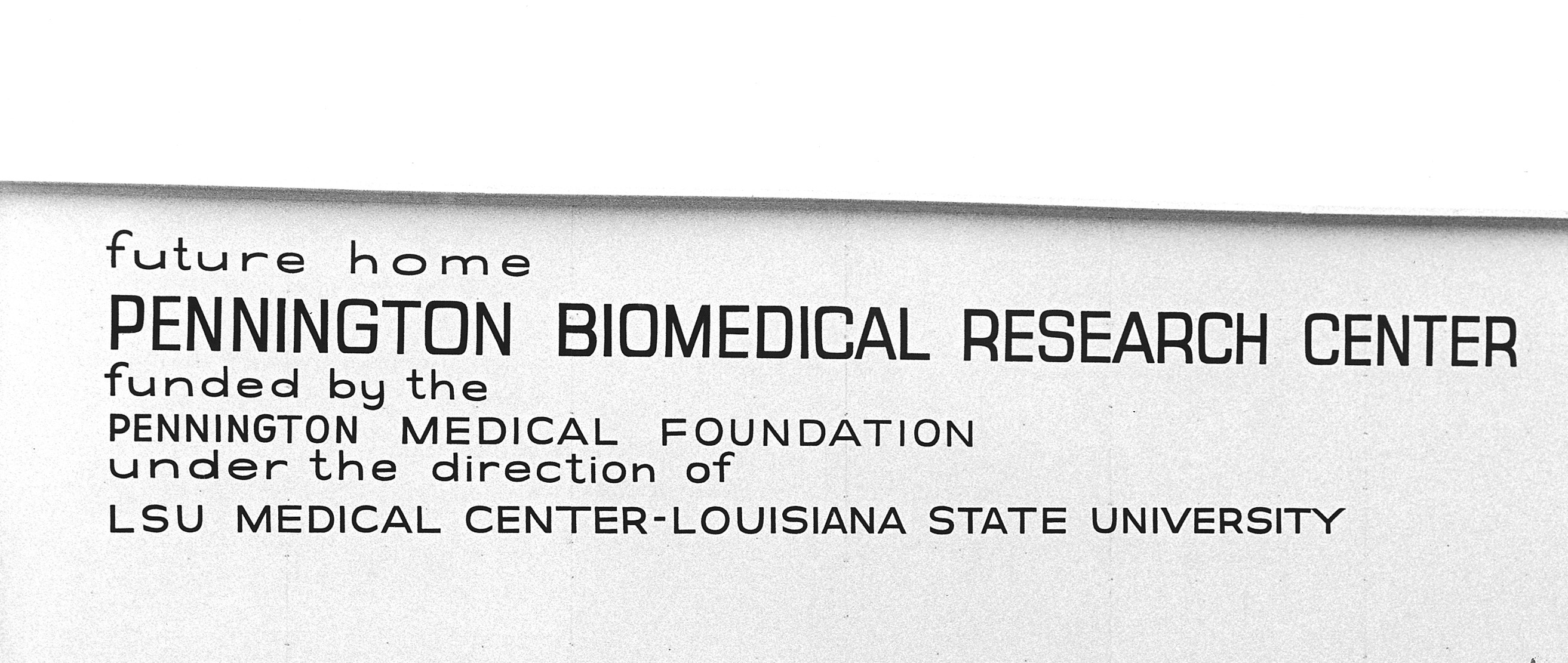
- Construction of Pennington Biomedical Research Center begins.
- Ground is broken on land owned by Louisiana State University along what is now Perkins Road.
- C.B. "Doc" Pennington and his wife, Irene, pledge $125 million to Louisiana State University to build the biggest and best nutritional research facility in the nation. At the time it was the largest single gift to an institution of higher learning. The gift was made possible after Doc, an optometrist, bought land near Port Hudson where oil was discovered in 1977.


