


News Feed

Americans with Severe Obesity Receive Fewer Surgeries Despite Rising Need
Researchers from LSU’s Pennington Biomedical Research Center and collaborating institutions have found that Americans with the highest levels of obesity are undergoing fewer surgical procedures overall. These procedures include common operations like knee or hip replacement, hernia surgery, and surgery of the breast, prostate and colon – operations that are frequently done for cancer.
Learn More
OU Health Harold Hamm Diabetes Center Names Dr. John Kirwan as New Director
Diabetes is a critical health challenge in Oklahoma, with more than 14 percent of the state’s adult population diagnosed with the disease—surpassing the national average and making its widespread impact a defining public health challenge for the state. The University of Oklahoma is committed to reducing diabetes complications and related deaths in Oklahoma by 30% over five years.
Learn More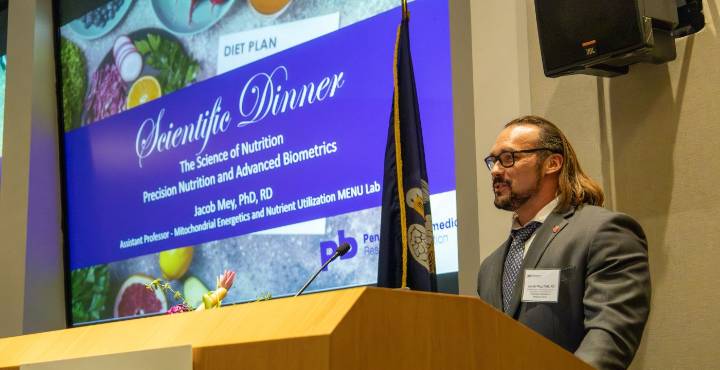
Dr. Jacob Mey Named a Media Spokesperson for the Academy of Nutrition and Dietetics
For more than four decades, the Academy of Nutrition and Dietetics' Media Spokesperson Program has amplified evidence-based nutrition and healthy eating messages to millions of Americans across media platforms. The Academy is proud to welcome six new registered dietitian nutritionists to the program of trained media experts who help translate nutrition science into clear, consumer-friendly information, including Pennington Biomedical Research Center’s Dr. Jacob Mey.
Learn More
Pennington Biomedical First to Estimate Pediatric Obesity Prevalence Using New Lancet Commission Definition
Researchers at Pennington Biomedical Research Center have published the first study to estimate the prevalence of pediatric obesity among U.S. children and adolescents using the new Lancet Commission definitions of preclinical and clinical obesity. The study, “Prevalence of Preclinical and Clinical Obesity Among US Children and Adolescents Aged 5 to 18 Years: NHANES 2017–2023,” published in the journal Obesity, was selected as an Editor’s Choice article in recognition of its scientific significance and potential impact on the field of pediatric obesity research.
Learn More
Pennington Biomedical Researchers to Present at the ADA’s 2026 Scientific Sessions in New Orleans
Researchers from LSU’s Pennington Biomedical Research Center are scheduled to present their latest findings in diabetes research and treatment at the American Diabetes Association’s (ADA) flagship conference, the 86th annual Scientific Sessions, taking place June 5-8 in New Orleans.
Learn More
Dr. Owen Carmichael Awarded James W. and Neil Ann Parks Professorship for Dementia Research, Prevention and Treatment
LSU’s Pennington Biomedical Research Center is pleased to announce that Dr. Owen Carmichael was awarded the James W. and Neil Ann Parks Professorship for Dementia Research, Prevention and Treatment.
Learn More
Pennington Biomedical Recruiting Adults with Type 2 Diabetes for Avocado Nutrition Study
LSU’s Pennington Biomedical Research Center is recruiting participants for a clinical nutrition study designed to investigate how daily avocado consumption may affect blood sugar management in adults with Type 2 diabetes. The Avocado-T2D study will examine the effects of eating one avocado each day on fasting blood glucose, glycemic control and insulin sensitivity. Researchers hope the findings will help advance evidence-based nutritional strategies for people living with Type 2 diabetes.
Learn More
New International Study Highlights Impact of Restrained Sitting on Movement Behaviors in Young Children
Researchers at LSU’s Pennington Biomedical Research Center, in collaboration with investigators from 32 countries participating in the SUNRISE International Study, have published new findings examining how restrained sitting contributes to daily movement patterns in early childhood.
Learn More
LSU Surpasses $600 Million in Research Activity, Continuing Multi-Year Historic Rise Across Unified Flagship
LSU’s Flagship has surpassed $600 million in annual research activity, building on last year’s record-setting milestone when the campuses exceeded $500 million for the first time ever. This marks the fifth consecutive year of record-breaking research wins. “This is not a one-time jump. It is a trajectory,” said Chancellor Jim Dalton. “We are building exceptional momentum across every single flagship campus.”
Learn More
Dr. John Apolzan and Dr. Leanne Redman Named 2026 Excellence in Nutrition Fellows
Two researchers from LSU’s Pennington Biomedical Research Center have been named 2026 Excellence in Nutrition Fellows of the American Society for Nutrition, or ASN, recognizing their significant contributions to nutrition science and sustained engagement in the nutrition community. Dr. John Apolzan and Dr. Leanne Redman were selected for the Fellows of ASN, or FASN, designation, an honor awarded to nutrition professionals who have demonstrated substantial impact in research, translational science and service to the field.
Learn More
2025 Publication of the Year Award
The Publication of the Year Awards recognize outstanding scientific contributions by Pennington Biomedical faculty whose research demonstrates exceptional innovation, impact, and advancement of knowledge in obesity, metabolism, nutrition, and related biomedical sciences. These awards highlight the breadth and excellence of research conducted across the Center and celebrate publications that have significantly influenced their respective fields during the past year.
Learn More
Study to Evaluate Family Healthy Weight Program for Childhood Obesity in Primary Care Clinics in Louisiana and Tennessee
Pennington Biomedical Research Center, in collaboration with Vanderbilt University Medical Center, has launched a research study, the COACH trial, to test different ways to help children and their families improve their health through lifestyle changes delivered by primary care clinics in communities in Louisiana and Tennessee. The COACH trial is enrolling 900 children ages 5 to 17 with obesity, which is classified as a BMI at or above the 95th percentile for their age and sex. Patients and their parents are being recruited through urban, suburban and rural doctor’s offices in Tennessee and Louisiana.
Learn More
Study Shows Use of Obesity Drugs Alongside Behavioral Intervention is Associated with Reduced “Food Noise”
New research presented at this year’s European Congress on Obesity in Istanbul, Turkey, shows that use of obesity drugs alongside behavioral interventions leads to a larger drop in so called ‘food noise’ than in those using the behavioral therapy alone. The study is by Dr. Hanim Diktas, postdoctoral researcher at LSU’s Pennington Biomedical Research Center in Baton Rouge, La., and colleagues.
Learn More
Pennington Biomedical Contributes to Global Study on Physical Activity and Well-Being
Research from LSU’s Pennington Biomedical Research Center is part of a major international study published in Nature Human Behaviour that offers new insight into how physical activity and emotional well-being are connected in everyday life. Researchers from Ruhr University Bochum, Paris Lodron University of Salzburg, the Karlsruhe Institute of Technology and the Central Institute of Mental Health Mannheim analyzed data sets from more than 8,000 people to investigate how physical activity is related to good mood and positive emotions. For most people, the result was that mood improves with everyday movement. At the same time, people are more physically active when they are feeling better.
Learn More
Pennington Biomedical Seeks Volunteers for Study on How the Body Regulates Weight
Pennington Biomedical Research Center is recruiting men and women for a research study designed to better understand how the human body regulates weight. The study, “Experimental Approach to Test Predictions of Body Weight Regulation Models (DIP Study),” will explore how energy intake, energy expenditure and biological responses interact to influence body weight. Findings from this research may help advance scientific understanding of metabolism and inform future approaches to obesity and weight management.
Learn More
The Critical Role of Exercise in the GLP-1 Era
As GLP-1 receptor agonists reshape obesity treatment, a new medical perspective published in the Journal of the American Medical Association, or JAMA, underscores a persistent gap in care: integrating exercise into weight management in ways patients can sustain. The perspective, “The Conundrum of Exercise for Weight Management in the GLP-1 Receptor Agonist Era,” examines the evolving role of physical activity alongside medications such as semaglutide, liraglutide and other GLP-1-based therapies. Authors included Pennington Biomedical’s Steven B. Heymsfield, M.D., and Harvard University’s Daniel E. Lieberman, Ph.D., and Daniel H. Aslan, Ph.D.
Learn More
Pennington Biomedical Convenes Global Experts to Advance Understanding of Ultra-Processed Foods and Health
LSU’s Pennington Biomedical Research Center recently hosted a two-day scientific symposium, “Ultra-Processed Food and Health: From Mechanisms to Actions,” bringing together many of the world’s leading experts to examine one of the most pressing topics in nutrition science. The symposium convened an international group of researchers, clinicians and policy experts to explore the rapidly evolving science surrounding ultra-processed foods and their impact on human health. Discussions spanned the biological mechanisms linking ultra-processed foods to chronic disease, the gaps in the available research, the role of the food environment and industry practices, and opportunities for policy and public health action.
Learn More
Dr. Hannah Cabré Appointed Assistant Professor and Director of the Aging, Gynecology, and Endocrinology Laboratory
LSU’s Pennington Biomedical Research Center is pleased to announce the appointment of Dr. Hannah Cabré as an Assistant Professor, effective May 1. Dr. Cabré, an emerging leader in the field of nutrition, aging and women’s health, will lead the newly established Aging, Gynecology, and Endocrinology Laboratory, after having trained as a postdoctoral fellow at the Center since May 2023 under mentors including Dr. Eric Ravussin and Dr. Leanne Redman.
Learn More
Dr. Hanim Ecem Diktas Shares Her Journey, Research and Advice as 2025 Outstanding Postdoctoral Fellow
Dr. Hanim Ecem Diktas, a postdoctoral researcher in Pennington Biomedical’s Ingestive Behavior, Weight Management and Health Promotion Laboratory, has been named the Center’s Outstanding Postdoctoral Fellow for 2025. Nominated by Dr. Corby Martin and Dr. John Apolzan, Dr. Diktas has quickly distinguished herself through a strong record of scholarly achievement, including 11 peer-reviewed publications, 22 abstracts and poster presentations, and service as a peer reviewer for five scientific journals.
Learn More
Pennington Biomedical Research Advances Understanding of How the Brain Senses Diet to Control Appetite and Metabolism
Researchers at Pennington Biomedical Research Center provide critical insight into how the brain and body work together to regulate food intake, energy use and metabolism – offering important new analysis into the biology of obesity and metabolic health. The study, “FGF21 signals through hindbrain neurons to alter food intake and energy expenditure during dietary protein restriction,” published in the journal Cell Reports and led by Pennington Biomedical Associate Executive Director for Basic Science Dr. Christopher Morrison and colleagues, focuses on Fibroblast Growth Factor 21 (FGF21), a hormone produced by the liver tat helps the body adapt to changes in diet and nutritional status.
Learn More


